AuDHD Explained: Signs, Symptoms, and How It Differs From Autism or ADHD Alone
#TalkNerdyToMe® Staff Writer
If you have ever felt like two people are fighting for control of your brain, one who needs a rigid routine and one who gets bored by routine within a week, you may already know why the term AuDHD has spread so fast.
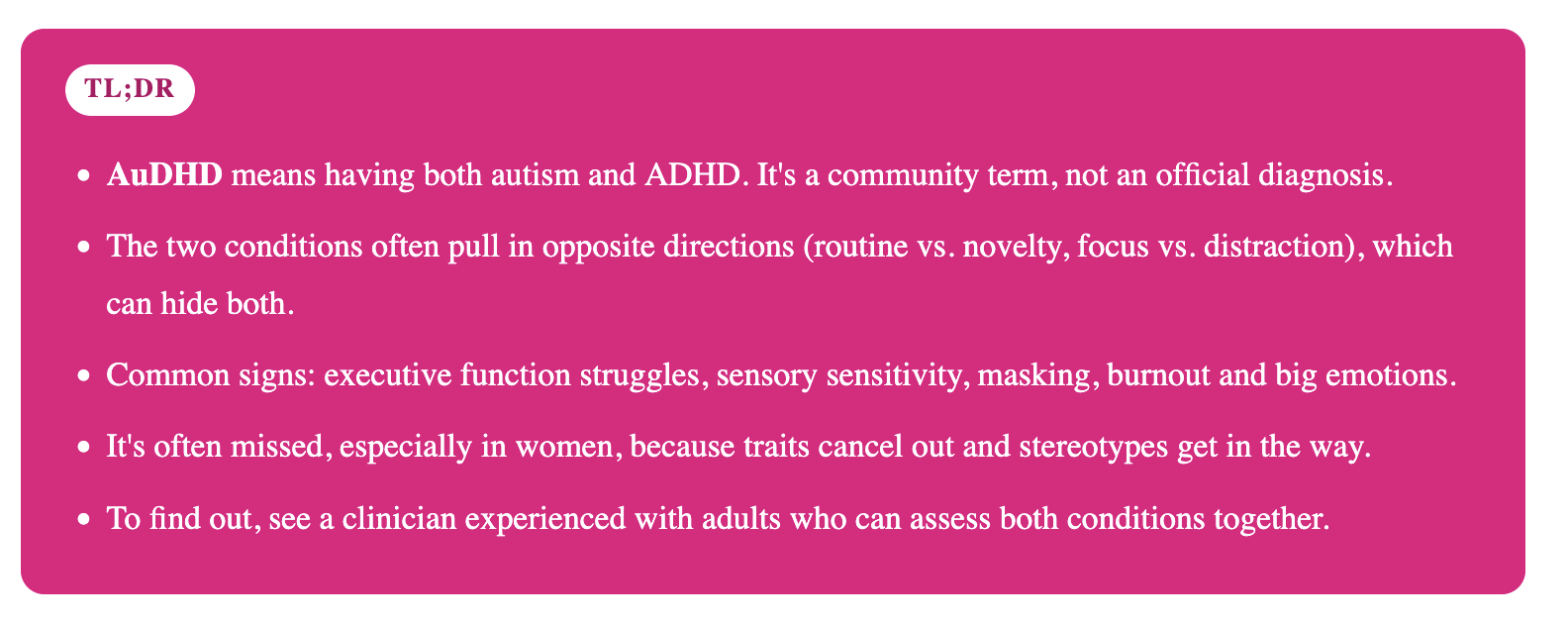
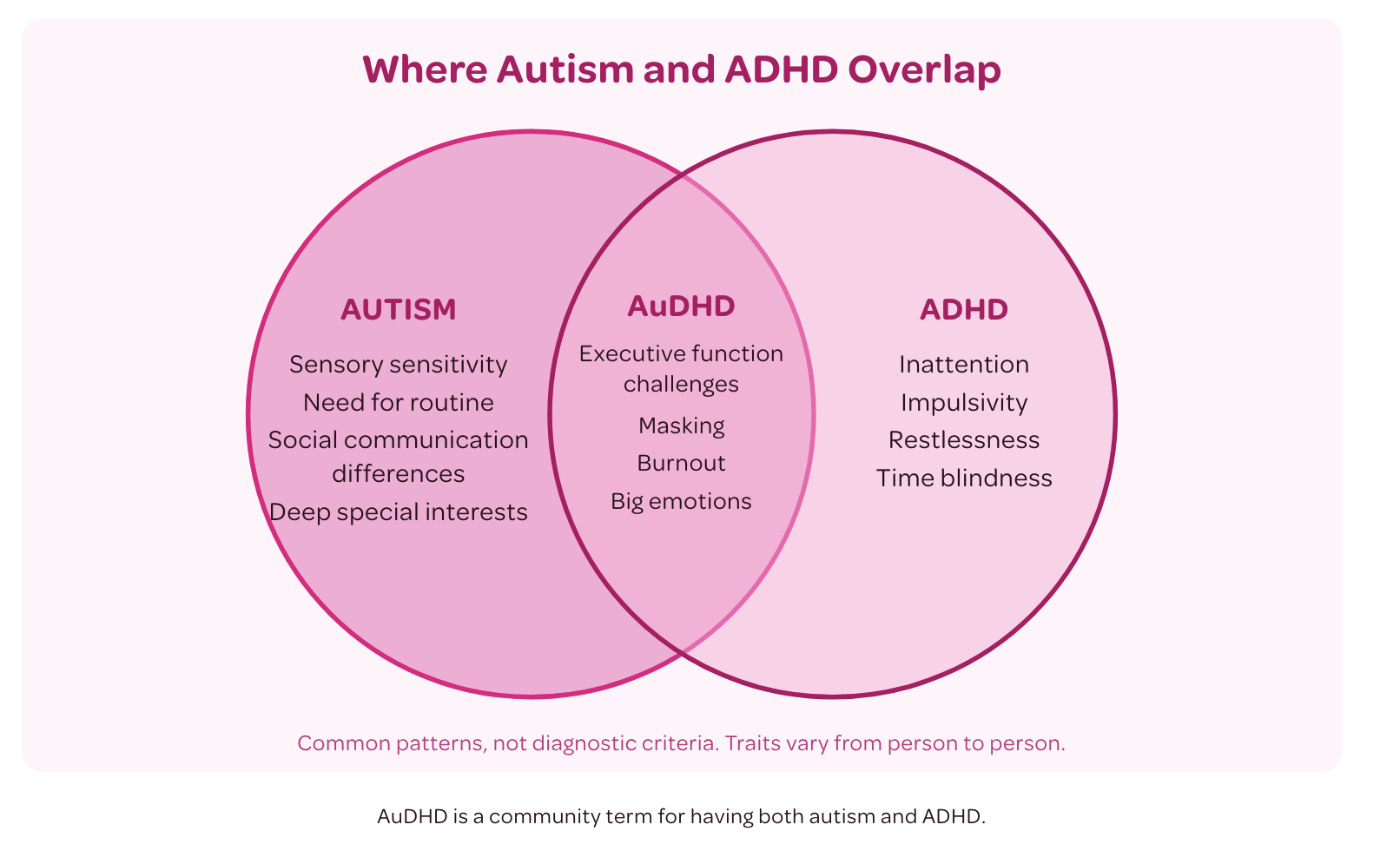
AuDHD is a community term for having both autism and ADHD. It isn't a separate diagnosis. It's shorthand for a person who meets criteria for two conditions that often overlap and often contradict each other.
What is AuDHD?
AuDHD combines Autism (autism spectrum disorder, ASD) and ADHD (attention-deficit/hyperactivity disorder). You won't find "AuDHD" as a diagnosis in the DSM-5 or ICD-11. A clinician diagnoses autism and ADHD separately, and the person who receives both calls themselves AuDHD.
For years, clinicians were not allowed to diagnose both conditions in the same person. That changed with the DSM-5 in 2013, which formally allowed a dual diagnosis. Many adults, especially women, are only now finding out they've had both all along.
How common is it?
Overlap is common. Studies vary widely depending on the sample and method, but research generally finds that a substantial share of autistic people also meet criteria for ADHD, often cited as somewhere between a third and a half or more. Rates run in the other direction too: many people with ADHD show significant autistic traits.
The takeaway is that these conditions co-occur far more often than chance would predict. Research also suggests they share genetic and neurological roots, which is part of why they so often show up together.
Signs and symptoms of AuDHD
Because it's two conditions, signs can look different from person to person. Here are the patterns most often described.
Executive function and attention
Trouble starting tasks even when you want to do them (task paralysis)
Hyperfocus that makes you lose hours, followed by exhaustion
Time blindness: "five minutes" can mean anything
Losing keys, phones and thoughts mid-sentence
Difficulty switching tasks, especially when interrupted
Sensory experience
Sensitivity to sound, light, textures, smells or crowds
Sensory seeking and sensory avoidance, sometimes in the same day
Strong reactions to clothing tags, fluorescent lights or background noise
Social and communication
Masking: studying and copying social behavior to fit in
Exhaustion after socializing, even with people you like
Blurting or interrupting (more ADHD-linked) alongside difficulty reading unspoken social rules (more autism-linked)
Preferring direct communication and finding small talk draining
Routines, interests and emotions
Craving routine and predictability, then feeling trapped by it
Intense special interests that can shift quickly
Big emotions, rejection sensitivity and difficulty regulating feelings
Meltdowns or shutdowns when overloaded
Daily living
A home or schedule that swings between rigid order and chaos
Burnout that arrives suddenly after long periods of coping
Needing more recovery time than other people seem to
The internal tug-of-war
People with AuDHD often describe a push and pull between traits that seem to oppose each other:
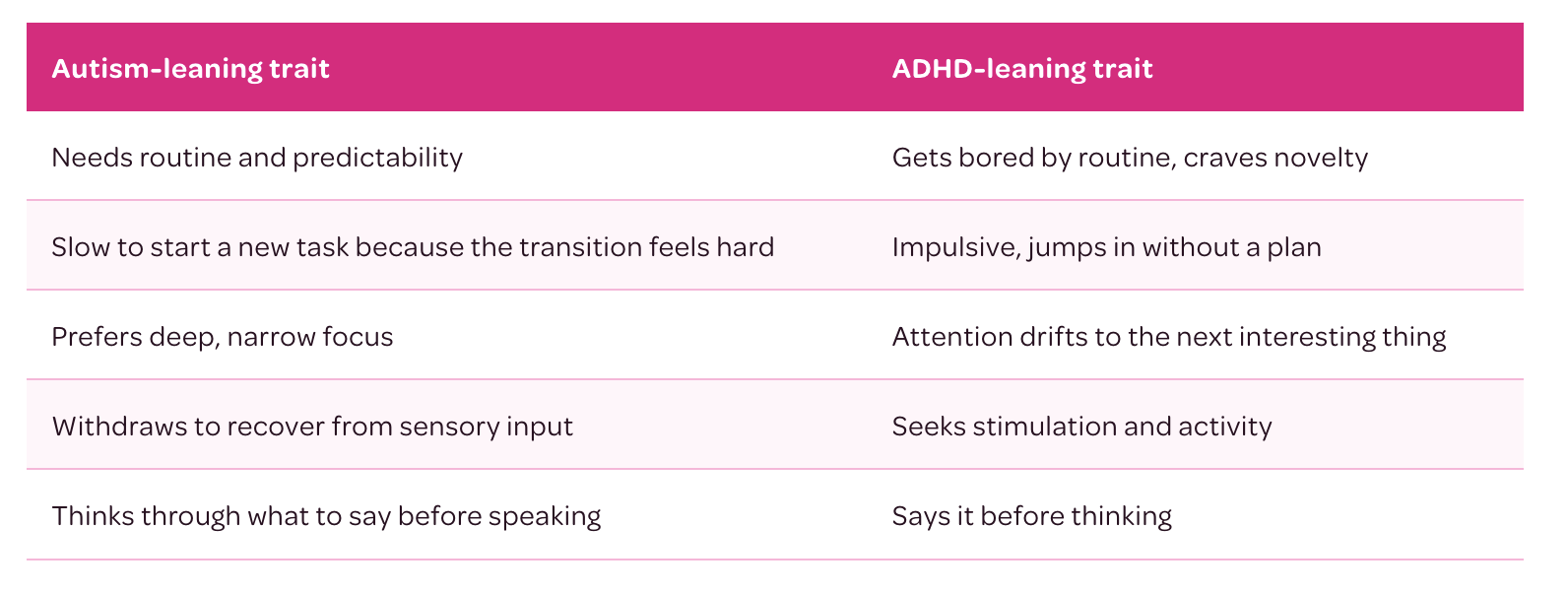
This conflict can be exhausting. It can also make each condition harder to spot, because the traits sometimes mask each other. Strong routines can hide ADHD, and impulsivity can hide autism. That is a big reason AuDHD often goes unrecognized for decades.
How AuDHD differs from autism alone
Autism alone is mainly defined by differences in social communication and by restricted, repetitive behaviors or interests, plus sensory differences. If you have autism without ADHD, your attention is usually less scattered, your energy is more consistent, and your routines are more likely to feel steadying than stifling.
With AuDHD, you add ADHD's attention regulation difficulty, impulsivity, restlessness and executive function challenges. Autistic strategies for coping, like rigid schedules and strict systems, may break down because the ADHD side can't keep them up.
How AuDHD differs from ADHD alone
ADHD alone is mainly defined by inattention, hyperactivity and impulsivity. If you have ADHD without autism, you may find social cues easier to read, adapt more easily to change, and feel less overwhelmed by sensory input.
With AuDHD, you add autistic sensory sensitivity, social communication differences, a strong need for predictability and a tendency toward burnout. Standard ADHD advice, like "just add more stimulation and variety," can backfire if your sensory system is already overloaded.
Why AuDHD is often missed
Masking. Many people, particularly women and people assigned female at birth, learn to hide traits from childhood.
Traits canceling out. As noted above, each condition can obscure the other.
Outdated stereotypes. The image of the hyperactive boy with ADHD or the withdrawn boy with autism still shapes who gets assessed.
Misdiagnosis. Many people are first told they have anxiety, depression, bipolar disorder or a personality disorder.
Late recognition. People often realize after their own child is diagnosed, or after burnout forces a rethink.
How to get assessed
Write down your experiences. Note childhood patterns, current challenges and examples. Clinicians value specifics.
Try screening tools as a starting point only. Questionnaires such as the AQ (autism) and ASRS (ADHD) can help you organize your thoughts, but they can't diagnose.
Seek a clinician experienced with adults and with both conditions. Ask directly whether they assess autism and ADHD together, and whether they have experience with women and late-diagnosed adults.
Expect a thorough process. Assessments usually involve interviews, history and sometimes input from family members who knew you as a child.
Ask about the full picture. A good evaluation also considers anxiety, depression, trauma and sleep, which can overlap or mimic symptoms.
Managing life with AuDHD
There's no one-size-fits-all approach, and any treatment decisions belong with a qualified clinician. Many people with AuDHD find these strategies helpful:
Build flexible routines, with structure that has room to move.
Use external supports like timers, visual schedules, body doubling and reminders.
Plan sensory recovery time after demanding days.
Reduce masking where it's safe to do so.
Work with your hyperfocus rather than against it, and schedule breaks so you don't crash.
Find community. Hearing from other AuDHD people can be a relief.
FAQ
Is AuDHD an official diagnosis?
No. It's a community term. A clinician diagnoses autism and ADHD separately.
Can you have autism and ADHD at the same time?
Yes. Since 2013 the DSM-5 has allowed both diagnoses together, and co-occurrence is common.
What does AuDHD feel like?
Many people describe it as wanting opposite things at once: structure and spontaneity, quiet and stimulation, focus and novelty.
Is AuDHD more common in women?
Women are often diagnosed later because they mask more and don't match the stereotypes. The condition itself isn't necessarily more common, but it may be more overlooked.
Can AuDHD be diagnosed in adults?
Yes. Many adults are diagnosed in their 30s, 40s and beyond.
Where can I start?
Start with a primary care provider or a psychologist or psychiatrist who works with neurodivergent adults.
The bottom line
AuDHD isn't two problems stacked on top of each other. It's one nervous system with a distinct pattern: contradictory needs, hidden strengths and a lot of effort spent coping without knowing why. If this sounds familiar, you aren't broken, and you aren't alone.
This article shares lived experience and general information. It isn't medical advice. If you think you may have autism, ADHD or both, please speak with a qualified healthcare professional.
